How to Choose the Perfect Moto Jacket for Fall
Quick Summary
Choose a moto jacket by fit first, then by material and purpose. Check sleeve length, armor alignment and hem coverage in a seated riding position, and make sure it fits over your thickest sweater. Faux leather suits everyday fall wear, while protective riding use calls for abrasion-resistant construction.
- Decide where you will wear the jacket and what you will layer beneath it.
- Measure chest, shoulders and sleeve against the size chart, not just the size label.
- Run a seated fit check: sleeve reaches the wrist bone, and armor sits over the joints.
- Try the jacket on over the thickest sweater you plan to wear in late fall.
- Choose faux leather for everyday fall wear; pick abrasion-resistant gear for riding protection.
Table of Contents
- Start With Your Fall Riding and Wearing Needs
- Moto Jacket Fit Guide: Checking Sizing for Layers and Movement
- How to Spot Quality Fabrics Before You Buy Online
- Leather vs. Faux-Leather Jacket: Which Works Better for Fall
- Fall Moto Jacket Outfit Ideas for Changing Temperatures
- Care and Returns: Keeping Your Fall Jacket in Shape
- Frequently Asked Questions
Start With Your Fall Riding and Wearing Needs
Before you compare styles, decide what the jacket has to do. A moto jacket for a daily commute, a weekend coffee run and a night out does not need the same weight or lining as one for long, cold stretches on a motorcycle.
Ask yourself three quick questions:
- Where will I wear it most? Office, errands or evenings out each point to a different level of structure and detail.
- What will I wear under it? A fine-knit sweater or a hoodie needs more room than a fitted tee.
- How cold does it get? Early fall often calls for a single layer. Late fall may call for a jacket that works over a sweater.
Watch out: Buying for the warmest day of the season leaves you under-dressed when the temperature drops. Plan around the coldest morning you expect to face.
Moto Jacket Fit Guide: Checking Sizing for Layers and Movement
Fit matters more than style once you start layering, and it matters most when you are actually on the bike. A moto jacket cut for a single top will pull at the shoulders and bind at the elbows when worn over a sweater, and a jacket that feels fine standing in front of a mirror can ride up, twist, or leave armor floating once you are seated with your hands on the bars.
Start with measurements, not size labels
Check the chest, shoulder and sleeve measurements against your own body measurements, not just the size label. Sizing varies by brand and by cut, so a medium in one jacket can fit like a large in another. Measure your chest at the fullest point, your shoulders across the back, and your sleeve from shoulder seam to wrist bone, then compare those numbers to the product's size chart. Check the Size Guide for the brand's full measurement details.
The seated fit check
Before you commit to a jacket, run this repeatable checklist while seated in a riding position, either on your own bike or on a chair with your feet forward and your arms reaching out to where the bars would be:
- Sleeve length: With your arms extended, the cuff should reach the wrist bone or just past it, with no gap between cuff and glove. Sleeves that stop short leave your wrists exposed to cold air and road spray; sleeves that bunch past the knuckles will push into your gloves and limit throttle control.
- Shoulder and elbow armor alignment: The armor should sit over the point of the shoulder and the point of the elbow, not above or below it. Reach forward and bend your elbows as if gripping the bars, if the elbow armor slides off the elbow point or the shoulder armor rides up toward the neck, the jacket is the wrong length or cut for you.
- Torso fit: The jacket should skim the body without ballooning at the waist or pulling across the chest. Too loose and it flaps at speed and lets cold air circulate; too tight and it restricts breathing and layering.
- Layering room: Wear the thickest sweater or hoodie you plan to use in late fall during the try-on. You want enough room to raise your arms overhead and twist your torso without the hem lifting above your waistband or the shoulders pulling tight.
- Hem and waist coverage: Seated, the hem should stay low enough to cover your waistband and lower back. A jacket that rides up when you sit leaves a cold gap right where wind hits hardest.
Watch out: A jacket that passes the standing mirror test can still fail the seated test, always check armor alignment and hem coverage in riding position before you remove tags.
Sizing up for layers
If you plan to wear the jacket over a hoodie or thick sweater, consider sizing up one step rather than reaching for a tight fit that will feel uncomfortable by late October. The trade-off is that a larger jacket may flap more when worn over a single tee; a jacket with adjustable waist tabs or a snap-down collar can help you cinch it down on warmer days and loosen it for layering on cold ones.
Use this checklist to compare the key seated-fit points before you commit to a jacket.
Fit check |
What to look for |
Why it matters |
|---|---|---|
Sleeve length |
Cuff reaches wrist bone or just past it |
Keeps wrists covered and clears gloves |
Armor alignment |
Shoulder and elbow armor sit over joint points |
Armor stays in place when riding |
Torso fit |
Skims the body without ballooning or pulling |
Limits flapping and cold air gaps |
Layering room |
Fits over your thickest planned sweater |
Allows arm and torso movement |
Hem coverage |
Covers waistband and lower back when seated |
Blocks wind where it hits hardest |
How to Spot Quality Fabrics Before You Buy Online
You cannot touch the fabric when you shop online, so read the product details closely. Look for the exact material and construction. Faux leather jackets vary widely in weight, finish and durability, and a clear listing tells you what you are getting. If you would rather shop with a team that handles the details, E-commerce retail from Edgy Elegance Boutique puts product specifications and sizing information front and center.
Use these checks:
- Material composition: Look for the stated fabric and coating. A polyester base with a polyurethane (PU) finish is a common construction for faux leather.
- Lining: A full lining makes the jacket easier to slide on and off and adds structure.
- Hardware and closures: Zippers and snaps should be described clearly. Sturdy hardware usually signals better overall construction.
- Care instructions: Clear care guidance is a good sign that the brand has considered how the piece will hold up over time.
Leather vs. Faux-Leather Jacket: Which Works Better for Fall
Leather and faux leather differ in weight, breathability, maintenance and wear. Use the framework below to compare the two on the factors that matter for the way you actually ride and wear a jacket in fall.
A neutral comparison framework
Judge any jacket, leather or faux, on these six factors, in this order:
- Protection and abrasion resistance: Leather has a long track record of abrasion resistance in a slide, which is why it remains the benchmark for riding gear. Faux leather varies widely; a thin polyurethane finish over a polyester base will not resist abrasion the way thick leather does, and many fashion faux-leather jackets are not built or tested as riding gear at all. If you plan to ride at highway speed, look for a jacket explicitly described as riding gear with abrasion-resistant construction and armor pockets, and check for a label or product description that states the protection level rather than assuming any moto-style jacket qualifies.
- Weather resistance: Neither material is waterproof on its own. Leather can absorb water and get heavy if it is not treated, and faux leather can let moisture through seams. For fall rain, look for a jacket with a water-resistant finish, sealed or covered seams, and, ideally, a removable waterproof liner. A jacket with a waterproof membrane or liner will outperform a fashion jacket in steady rain regardless of the outer material.
- Warmth: Leather blocks wind well and holds warmth, which is an advantage on cold mornings. Faux leather also blocks wind but insulates less. In both cases, warmth in fall comes mainly from what you layer underneath and whether the jacket has a removable thermal liner. A thermal liner extends a jacket's useful range into late fall; without one, you are relying entirely on your sweater.
- Ventilation: Leather breathes better than most faux leather, which matters on mild afternoons when you are working up heat at low speed or walking around off the bike. If you run warm, look for pit zips or vent panels; if the jacket has neither, plan to wear it open on warmer days.
- Weight: Leather is heavier, which some riders find reassuring and others find tiring on long days. Faux leather is lighter and easier to pack or carry once you are off the bike.
- Cost and care: Faux leather is usually more affordable and simpler to clean, a damp cloth and air drying handle most marks. Leather costs more upfront and needs conditioning to stay supple and resist water, but it can last many seasons and develop character.
How to decide for fall
For most fall wardrobes built around commuting, errands and evenings out, faux leather is the practical choice. It layers easily, looks polished with dresses or denim, and is simpler to care for. Real leather makes more sense if you want a long-term investment piece, ride frequently at speed, and are willing to maintain it.
Our Black Faux Leather Moto Jacket is built for everyday layering, with a classic silhouette and a smooth finish.

Fall Moto Jacket Outfit Ideas for Changing Temperatures
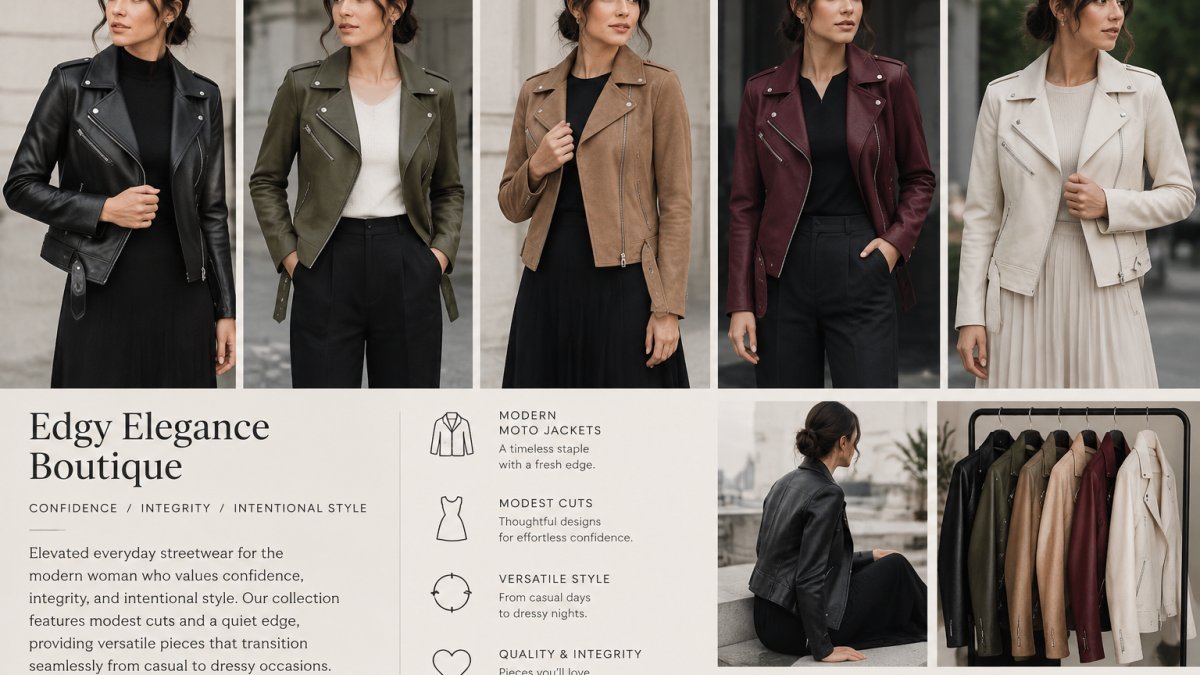
The best moto jacket is one you actually wear, so plan outfits before you buy. A black moto jacket pairs well with a fine-knit sweater and dark jeans for a cool morning, then works with a fitted tee and a midi skirt once the afternoon warms up. Over a hoodie and cargo pants, it reads as relaxed streetwear. Shop women's streetwear outfit sets for coordinated looks that need no styling.
Try these combinations:
- Moto jacket, fitted knit top, dark straight-leg jeans and ankle boots
- Moto jacket, lace-trimmed dress and slouchy knee-high boots
- Moto jacket, oversized hoodie, cargo pants and chunky sneakers
Our Black Slouchy Moto Boots work well with any of these looks.
Care and Returns: Keeping Your Fall Jacket in Shape
Faux leather needs gentle care. Wipe it with a soft, damp cloth and let it air dry away from direct heat.
Returns matter too. Edgy Elegance Boutique offers a 30-day guarantee.
Ready to find your fall jacket? Explore the Black Faux Leather Moto Jacket from Edgy Elegance Boutique, check our size guide, and build a look that carries you from the office to the weekend.
Frequently Asked Questions
What should I look for when buying a moto jacket?
Start with fit, fabric, and hardware. Check that the shoulders sit where yours do, that the sleeves are long enough when your arms are bent, and that the zipper and belt feel sturdy. Look at the material description for the shell and lining, and consider whether you need an everyday layer or something for cooler, wind-exposed days. A lined jacket in a midweight material suits most fall wardrobes, such as the Black Faux Leather Moto Jacket at $33.75, which features a fully lined polyester interior and a belted waist for adjustable fit.
How should a moto jacket fit for fall layering?
Choose a size that closes comfortably over a sweater or fine-knit top, not one that pulls at the chest or arms. Lift your arms and bend your elbows while wearing the jacket; the shoulder seams should not restrict you, and the sleeves should not ride up. Because fall outfits add layers, a relaxed but structured fit usually works better than a tight one. Keep the moto jacket fit guide in mind when you compare sizing charts, since boutique sizing varies.
Is a leather or faux-leather moto jacket better for fall?
For most fall days in the United States, faux leather is the more practical choice. It is lighter, requires less maintenance, and works well for everyday layering in mild to cool weather. Genuine leather offers durability and breathability over many years but costs more and needs conditioning. Faux leather made from polyester with a polyurethane coating, like the Black Faux Leather Moto Jacket, gives the classic look at a lower price point.
Can you wear a moto jacket in the rain?
A standard moto jacket is not fully waterproof. A faux leather shell can shed light drizzle, but seams and zippers may let water through in steady rain. For wet days, pair the jacket with an umbrella or a separate rain shell, and wipe the surface dry afterward to protect the finish.